Overview
Synopsis
Michael Frayn's Noises Off takes a fond look at the follies of theatre folk, whose susceptibility to out-of-control egos, memory loss, and passionate affairs turn every performance into a high-risk adventure. This play-within-a-play captures a touring theatre troupe’s production of Nothing On in three stages: dress rehearsal, the opening performance, and a performance towards the end of a debilitating run. Frayne gives us a window into the inner workings of theatre behind the scenes, progressing from flubbed lines and missed cues in the dress rehearsal to mounting friction between cast members in the final performance. Brimming with slapstick comedy, Noises Off is a delightful backstage farce, complete with slamming doors, falling trousers, and -- of course -- flying sardines!
Show Information
Context
The farce-within-a-farce Noises Off debuted in London in 1982, at the Lyric Theatre, directed by Michael Blakemore and starring Patricia Routledge, Paul Eddington, and Nicky Henson. Immediately a popular hit, the production transferred to the West End, where it won the Olivier Award for Best Play and the London Evening Standard Award for Best Comedy, both in 1982. This production ran for five more years with five different casts, while Blakemore opened a second production opening on Broadway
to read the context for Noises Off and to unlock other amazing theatre resources!Plot
Act One
It appears to be a sunny afternoon in a beautiful and substantial country home (“16th-century posset mill, lovingly converted”), and Mrs. Clackett, a housekeeper of character, is juggling a plate of sardines and a phone call in which she explains that the owners of the house live in Spain, and that she is off work, but intends to put her feet up with a plate of sardines and watch some television.
After the call is over, however, some confusion over whether she should leave
to read the plot for Noises Off and to unlock other amazing theatre resources!Characters
Showing 8 of 9 characters
Character Portrayals
See StageAgent members who have performed roles in Noises Off.
Showing 8 of 29 portrayals




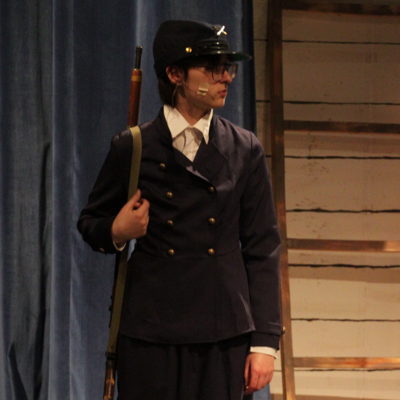


Want to be featured on this page? Update your credits.
Monologues
Themes, Symbols & Motifs
Themes
The Chaos Beneath Comedy
At its core, Noises Off explores the messy, unpredictable, and often chaotic reality of creating live theatre. While the play within a play (Nothing On) is a farce filled with slamming doors and missed cues, the backstage story reveals even greater turmoil, highlighting how difficult it is to bring order to a collaborative art form.
Illusion vs. Reality
The play constantly blurs the line between performance and real life. Characters’ personal
to read about the themes, symbols and motifs from Noises Off and to unlock other amazing theatre resources!Key Terms
A cue is a signal in theatre that prompts an actor, technician, or musician to carry out a specific action. Cues may be verbal, visual, or technical, such as a line of dialogue, a gesture, or a lighting change. Successful cueing ensures smooth transitions and precise timing throughout a performance.
A group of performers who function as a unit in a production rather than as individuals with leading roles.
Farce is a comedic style that emphasizes exaggerated situations, improbable coincidences, mistaken identities, and rapid pacing. It often includes physical humor such as slamming doors, frantic chases, or characters hiding in plain sight. Farce is designed to generate nonstop laughter, often prioritizing chaos and absurdity over realistic storytelling.
The imaginary wall separating the audience from the actors onstage, often 'broken' for direct address. This term plays a vital role in understanding theatrical structure and is commonly encountered in stagecraft or performance settings.
A form of self-referential drama where the play draws attention to its own theatricality. This device challenges the audience’s suspension of disbelief and is used in Epic Theatre and postmodern works.
A play within a play is a dramatic device in which a secondary performance is staged inside the larger work. This inner play can mirror, parody, or contrast with the main story, often adding layers of meaning or humor. It allows the audience to reflect on the nature of performance, illusion, and storytelling itself.
Slapstick is a type of physical comedy that relies on exaggerated actions, pratfalls, and humorous accidents to provoke laughter. It often includes broad movements, funny sound effects, and comic violence, such as someone slipping on a banana peel or being hit with a harmless object. The style originated in commedia dell’arte and became popular in vaudeville, silent film, and stage comedy.
Videos
Quizzes
Guide Written By:
