
Overview
Synopsis
Singin’ in the Rain, beloved since the moment it premiered, earned the top spot atop AFI’s 100 Years of Musicals list and, in 2007, was ranked as the fifth greatest motion picture of all time. Now adapted for the stage, Singin' in the Rain “pours” down delight, capturing the waning days of the silent screen era as they give way to new-fangled “talkies”. With The Jazz Singer premiere making Hollywood frantic, the studios are forced to suddenly change all the movie-making rules at once, to accommodate sound. In doing so, they leave silent pictures -- and some of their stars -- behind. When Monumental Studios turns silent The Dueling Cavalier into The Dancing Cavalier, a musical picture, in order to stay relevant, they are faced with a problem: their star, Lina Lamont can’t sing, and can’t even really talk. Lina’s voice sounds something like nails on a chalkboard. Enter Kathy Selden, an aspiring actress whose dulcet tones are able to cover Lina Lamont’s -- calling into question what it means to act, how credit is distributed, and what it means to get a fair shake in the movie business. Singin' in the Rain includes some of the best-loved comedy routines, dance numbers, and love songs ever written, including “Good Mornin’”, “Make ‘em Laugh”, and of course the show-stopping dance number, “Singin’ in the Rain”.
Show Information
Context
Adapted from the film of the same name, Singin’ in the Rain closely follows the original 1952 film script. The show had its world premiere at the London Palladium on June 30th, 1983, directed by Tommy Steele and choreographed by Peter Gennaro. The original film’s vocal score was used and had many tunes added to it by composer team Comden & Green, as well as songs by the Gershwins, Cole Porter, and Roger Edens. The show was a success, running until September 1985. Singin’ in the Rain opened
to read the context for Singin’ in the Rain and to unlock other amazing theatre resources!Plot
ACT ONE
A massive crowd gathers in front of Hollywood’s Chinese Theatre, hoping to catch a glimpse of the actors arriving for a star-studded premiere of the latest Lockwood & Lamont picture, “The Royal Rascal”. The dashing Don Lockwood and the lovely Lina Lamont - the stars of the picture - have been romantically linked in the press and are being questioned by gossip columnist Doris Bailey about their relationship. In the interview, Doris persuades Don to tell the story of his rise to
to read the plot for Singin’ in the Rain and to unlock other amazing theatre resources!Characters
Showing 8 of 16 characters
Character Portrayals
See StageAgent members who have performed roles in Singin’ in the Rain.
Showing 8 of 51 portrayals



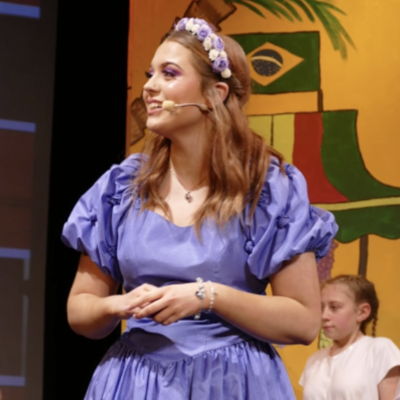



Want to be featured on this page? Update your credits.
Songs
Act One
- Overture - Orchestra
- *Fit as a Fiddle - Don Lockwood, Cosmo Brown
- The Royal Rascal - Orchestra
- You Stepped Out of a Dream - Don Lockwood & Company
- *All I Do Is Dream Of You - Kathy Selden and Girls of the Coconut Grove
- You Stepped Out of a Dream (Reprise) - Don Lockwood
- *Make 'Em Laugh - Cosmo Brown
- *Beautiful Girls - Production Tenor and Female Chorus (including Kathy Selden)
- You Are My Lucky Star - Kathy Selden
- *You Were Meant For Me - Don Lockwood & Kathy Selden
- *Moses Supposes - Don Lockwood, Cosmo Brown
- *Moses Supposes (Reprise) - Company
- *Good Morning - Don Lockwood, Cosmo Brown, Kathy Selden
- *Singin' in the Rain - Don Lockwood
Act Two
- Entr'acte - Orchestra
- *Good Morning (Reprise)- Company
- Would You? - Kathy Selden
- What's Wrong With Me? - Lina Lamont
- *The Broadway Ballet (aka Broadway Rhythm) - Cosmo Brown, Don Lockwood, and Full Company
- *Would You? (Reprise)- Kathy Selden (Voicing for Lina) & Cosmo Brown
- You Are My Lucky Star (Reprise) - Kathy Selden and Don Lockwood
- *Singin' in the Rain (Finale) - Full Company
This is the song list from the most recent Chichester / London 2012 Revival.
A song with an asterisk (*) before the title indicates a dance number; a character listed in a song with an asterisk (*) by the character's name indicates that the character exclusively serves as a dancer in this song, which is sung by other characters.
Key Terms
An adaptation is a reworking of a story from one medium or cultural context into another, such as turning a novel into a play or updating a classic play’s setting. Adaptations often reinterpret themes, characters, and style for new audiences. They can range from faithful recreations to bold reimaginings.
The art of designing and arranging movement sequences for theatrical dance and physical storytelling.
A form of self-referential drama where the play draws attention to its own theatricality. This device challenges the audience’s suspension of disbelief and is used in Epic Theatre and postmodern works.
The Silent Film Era refers to the period in cinema history from the late nineteenth century until the late 1920s when motion pictures had no synchronized recorded sound. Filmmakers relied heavily on visual storytelling, expressive acting, body language, and title cards to convey plot and emotion to the audience.
Slapstick is a type of physical comedy that relies on exaggerated actions, pratfalls, and humorous accidents to provoke laughter. It often includes broad movements, funny sound effects, and comic violence, such as someone slipping on a banana peel or being hit with a harmless object. The style originated in commedia dell’arte and became popular in vaudeville, silent film, and stage comedy.
Early film with synchronized sound, a revolutionary shift often referenced in plays about the film industry.
Tone deafness is an auditory condition characterized by an inability to perceive differences in musical pitch or reproduce musical tones accurately. In musical theatre, references to pitch perception often highlight character differences, educational background, or vocal skill during comic and dramatic interactions.

