Overview
Synopsis
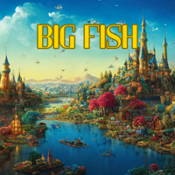
Edward Bloom has lived a full and fantastical life, populated by witches, giants, and mermaids, marked by true love that stops time in its tracks, and framed by heroics that push the limits of believability. His adult son, Will, is no longer amused by his father’s fantastical tales, insisting on a rational rather than a fantastical account of one’s life. When Edward’s health declines, and Will learns that he and his wife, Josephine, will have a son of their own, Will decides to find out his father’s “true” life story, once and for all. Big Fish is a heartfelt, powerful, and truly magical musical about fathers, sons, and the stories that we use to define our identities. With spine-tinglingly beautiful music and lyrics by Andrew Lippa, and a funny, heartwarming book by John August, Big Fish is a magnificent “big fish” of a tale, itself -- spectacular, fantastical, and overflowing with love.
Show Information
Context
Big Fish the musical is adapted from two sources: Daniel Wallace’s 1998 novel Big Fish: A Novel of Mythic Proportions and its 2003 film adaptation, directed by Tim Burton. The novel, which is told from Will’s point of view in first-person, is a chronological retelling of the tall tales Will’s father, Edward, told about his life. The novel draws inspiration from classic literature and mythology. For example, like Odysseus in Homer’s The Odyssey, Edward Bloom is on a seemingly endless quest
to read the context for Big Fish and to unlock other amazing theatre resources!Plot
Act One
In Alabama, an aging man named Edward Bloom skips stones on a river. His son, Will, approaches. It’s Will’s wedding day, and he urges his father not to make any embarrassing toasts or tell any wild stories. Edward is befuddled by this request, but agrees. Edward enters a flashback, in which he tells six-year-old Will a story before bed. In the story, which comes to life, Edward encounters a group of men and women who are unsuccessfully trying to catch a fish. Edward informs them
to read the plot for Big Fish and to unlock other amazing theatre resources!Characters
Showing 8 of 13 characters
Interactive Character Map
Visualize how the characters in Big Fish connect and drive the story.
Understand the relationships that shape the story of Big Fish
- See how characters connect at a glance
- Explore alliances, conflicts, and dynamics
- Dive deeper into each role
Character Portrayals
See StageAgent members who have performed roles in Big Fish.
Showing 8 of 71 portrayals








Want to be featured on this page? Update your credits.
Songs
Showing 8 of 18 songs
A song with an asterisk (*) before the title indicates a dance number.
Themes, Symbols & Motifs
Themes
The Power of Storytelling – Edward Bloom’s fantastical tales shape his identity and legacy, emphasizing how stories can preserve memory, inspire imagination, and connect generations.
Father–Son Relationships – At the core of the musical is the strained yet loving bond between Edward and Will, exploring themes of reconciliation, understanding, and the complexities of family.
Truth vs. Exaggeration – The tension between Edward’s mythic storytelling and Will’s demand for facts
to read about the themes, symbols and motifs from Big Fish and to unlock other amazing theatre resources!Key Terms
An adaptation is a reworking of a story from one medium or cultural context into another, such as turning a novel into a play or updating a classic play’s setting. Adaptations often reinterpret themes, characters, and style for new audiences. They can range from faithful recreations to bold reimaginings.
Allegory is a storytelling device in which characters, events, and settings represent abstract ideas or moral qualities. In theatre, allegorical plays often deliver social, political, or religious messages beneath their surface narrative.
Catharsis is the emotional release experienced by the audience at the conclusion of a tragedy or intense dramatic work. It allows viewers to purge feelings of fear, pity, or tension through the resolution of the play’s conflict. The concept dates back to Aristotle, who believed catharsis was central to the purpose of theatre.
A genre of story involving magical and fantastical elements, sometimes adapted for theatrical performance.
A dramatic device that transports the narrative to an earlier time to provide background or context.
A literary and theatrical style blending realistic narrative with fantastical elements to explore complex truths.
A literary device comparing two unlike things without using 'like' or 'as,' used in theatre to add symbolic meaning. Metaphors enhance subtext and deepen character understanding.
The main character of a play or story, typically the one whose journey or conflict drives the plot. The protagonist often experiences growth or change.
A movement and technique using symbolic imagery and metaphors to express abstract ideas and inner experiences.
A tableau is a staged moment where performers freeze in a visually powerful pose or arrangement, almost like a living picture. Instead of dialogue or movement, the image itself communicates the meaning—whether it’s celebrating triumph, mourning loss, or showing a turning point in the story. In an opera such as Ça Ira, which dramatizes the French Revolution, tableaux are often used to symbolize big events like the storming of the Bastille or the collective spirit of the people.
Videos
Guide Written By:
