
Overview
Synopsis
A landmark in American drama, Thornton Wilder’s Pulitzer Prize-winning Our Town tells the story of a small town, Grover’s Corners, New Hampshire, in order to tell us the story of every town, the whole world over. Narrated by the “Stage Manager”, we follow the Gibbs and Webb families, residents of Grover’s Corners, through twelve years of life changes -- from the mundane in Act I, “Daily Life,” to the romantic in Act II, “Love and Marriage,” to the devastating in Act III, “Death and Eternity.” Through the young lovers Emily and George, their strong and loving parents, and the many other Grover’s Corners’ locals, Wilder delivers universal truths about what it means to be human. “Oh, earth,” Emily Webb exclaims towards the play’s end, “you’re too wonderful for anyone to realize you.” With humor, wit, and exceptionally powerful storytelling, Our Town offers a unique opportunity for audience members to make precisely that realization.
Show Information
Context
Thornton Wilder was originally a Pulitzer Prize-winning novelist, but critics argued that his work was escapist fare that did little to confront the enormous issues of the Depression era. In response, Wilder turned to playwriting. His first play, Our Town, opened on Broadway in 1938 to rave reviews and eventually won him his second Pulitzer Prize. However, unlike the many plays of the time that took a cynical look at American life, Wilder’s Our Town instead embraced the nature of small town
to read the context for Our Town and to unlock other amazing theatre resources!Plot
Act One - Daily Life
The play begins with an open, empty space. The Stage Manager enters and rearranges a few pieces of furniture -- a table and three chairs -- as the lights dim. Once the theatre is completely dark, the Stage Manager sets the scene: “This play is called ‘Our Town...’ The name of the town is Grover’s Corners, New Hampshire… The day is May 7, 1901. The time is just before dawn.” He introduces the customs and landmarks of the town, concluding by informing the audience that
to read the plot for Our Town and to unlock other amazing theatre resources!Characters
Showing 8 of 17 characters
Character Portrayals
See StageAgent members who have performed roles in Our Town.
Showing 8 of 86 portrayals





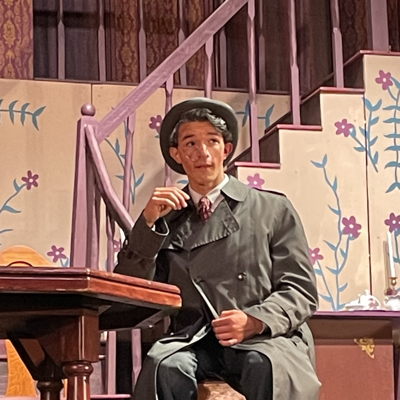
Want to be featured on this page? Update your credits.
Monologues
Scenes
Themes, Symbols & Motifs
THEMES
Living in the Present and Appreciating the Everyday
At its core, Thornton Wilder’s Our Town addresses the tragedy of human inattention—the idea that people move through their lives wrapped up in minor anxieties, routine chores, and future plans, failing to appreciate the quiet magnificence of the present moment. Through the Stage Manager’s meta-theatrical commentary and the depiction of everyday occurrences in the small community of Grover's Corners, the play continuously
to read about the themes, symbols and motifs from Our Town and to unlock other amazing theatre resources!Director Insights
Our Town relies entirely on theatrical conventions, imagination, and the audience's willingness to accept mime and minimal staging. The dramatic engine of the play is not the everyday life of Grover’s Corners, but the contrast between that everyday life and the immense scale of eternity.
One effective approach is to anchor the production in total theatrical honesty. The Stage Manager serves as the bridge between the world on stage and the world in the audience, setting a tone of intimacy and direct communication from the first moment. The emotional core of Thornton Wilder’s vision is that human beings rarely appreciate life while they are living it. Emphasizing the rhythm of daily life—the clinking milk bottles, the schoolyard chatter, the evening choir rehearsals—makes Act III’s cemetery scene hit with devastating clarity.
Consider avoiding overly sentimental approaches. The play
to read the director insights for Our Town and to unlock other amazing theatre resources!Discussion Questions
Big Question
How does knowing that life is temporary change the way we value everyday, ordinary moments?
Discussion Questions
- How does the Stage Manager’s role as both a narrator and a participant in the community shape the way the audience experiences the town of Grover's Corners?
- In Act I, Thornton Wilder goes to great lengths to detail the daily routines of the Gibbs and Webb families. Why do you think the play spends so much time on mundane activities like getting ready for school and delivering milk?
- How do the differing expectations for young men and young women in Grover’s Corners influence the choices available to characters like Emily Webb and George Gibbs?
- Simon Stimson’s struggle with alcoholism and unhappiness stands out in an otherwise quiet town. How do the residents of Grover’s Corners respond to him, and what does his story reveal about the community’s social boundaries?
- What does the conversation between Emily and George at the soda fountain reveal about their feelings for each other and their feelings about growing up?
- How do the wedding preparations in Act II highlight both the comfort and the pressure that small-town traditions bring to major life milestones?
- Mrs. Gibbs dreams of visiting Paris, but her desire goes unfulfilled. What does her unmapped ambition suggest about the sacrifices people make for family and routine?
- When Emily revisits her ninth birthday in Act III, what does she realize about the living that she was unable to see while she was alive?
- How do the dead characters in Act III view the living, and why do you think their perspective shifts as time passes?
- What role does the passage of time play across the three acts, and how does Wilder structure the narrative to move from the ordinary to the extraordinary?
- The Stage Manager mentions that "something is eternal" about every human being. Based on the events and characters in the play, what do you think the play considers to be truly eternal?
- Emily famously asks if any human beings ever realize life while they live it—every, every minute. Reflecting on your own daily routine, what is one ordinary moment you often take for granted, and how might viewing it through Emily's perspective change how you experience it?
Key Terms
An actor plant is someone intentionally placed in the audience to influence reactions, often by laughing, applauding, or participating at key moments. This technique can heighten the energy of a performance or encourage genuine audience responses. It is sometimes used in marketing or immersive theatre.
The deliberate use of stylized, non-naturalistic elements in theatre to emphasize that the production is a constructed artistic creation.
Innovative performance styles that challenge traditional theatre conventions.
A form of self-referential drama where the play draws attention to its own theatricality. This device challenges the audience’s suspension of disbelief and is used in Epic Theatre and postmodern works.
A small-scale representation of a larger concept, often used in plays to explore universal themes through confined settings.
A theatrical style that emphasizes simplicity in staging and dialogue to focus attention on core themes and performance.
A narrative voice that knows all thoughts, actions, and events. Omniscient narration is used in epic theatre and storytelling to provide a broad, external perspective.
A performance style using exaggerated physical gestures and expressions rather than speech. Pantomime is a key component of Commedia dell’arte and children’s theatre.
A member of a Protestant sect that opposed theatre in 17th-century England. Their influence contributed to the temporary closure of theatres during that era.
A character or theme denoting impermanence, often used to explore societal change or alienation in drama.
Videos
Quizzes
Guide Written By:
