
Overview
Synopsis
Welcome to the Renaissance, where the Black Plague has ceded power to the Puritans, farthingales and codpieces are the latest fashion trend, and the biggest celebrity in England is a playwright named William Shakespeare. In the midst of all this excitement, brothers Nick and Nigel Bottom are trying to keep their acting company afloat. In a desperate attempt to out-Bard the Bard, Nick consults with a soothsayer, who informs him that the future of theatre involves acting, singing, and dancing -- sometimes all at once! As the Bottom brothers strive to write the world’s very first “musical”, they find themselves caught in a bitter battle with the Bard and the play's the thing. Something Rotten! is a hysterical, joyous celebration of everything you love about Broadway.
Show Information
Context
Something Rotten! is a musical comedy idea that began with brothers Karey and Wayne Kirkpatrick in the 1990s. They joined forces with John O’Farrell to write several songs, which were presented to producer Kevin McCollum in 2010. The team joined forces with prominent theater director and choreographer Casey Nicholaw to do a workshop of the show in 2014.
The show was due to have a pre-Broadway tryout at 5th Avenue Theatre in Seattle, Washington in April 2015, but when a Broadway theater
to read the context for Something Rotten! and to unlock other amazing theatre resources!Plot
ACT ONE
The musical opens on the streets of London with Minstrel welcoming the audience to the Renaissance (“Welcome to the Renaissance”). We meet Nick and Nigel Bottom, struggling playwright brothers who are trying to outshine the wildly popular playwright William Shakespeare, now a rockstar-like figure. The Bottom brothers are rehearsing their upcoming play, Richard II, when Lord Clapham, a patron of the troupe, announces that Shakespeare is doing his own Richard II. Nick is
to read the plot for Something Rotten! and to unlock other amazing theatre resources!Characters
Showing 8 of 12 characters
Interactive Character Map
Visualize how the characters in Something Rotten! connect and drive the story.
Understand the relationships that shape the story of Something Rotten!
- See how characters connect at a glance
- Explore alliances, conflicts, and dynamics
- Dive deeper into each role
Character Portrayals
See StageAgent members who have performed roles in Something Rotten!.
Showing 8 of 101 portrayals







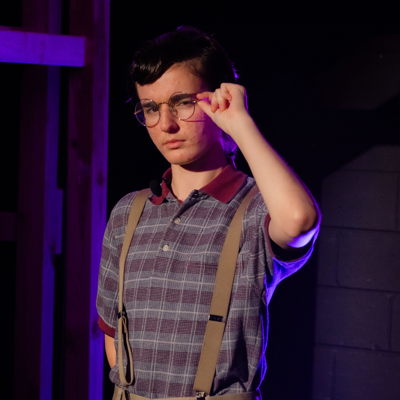
Want to be featured on this page? Update your credits.
Songs
Showing 8 of 17 songs
A song with an asterisk (*) before the title indicates a dance number.
Themes, Symbols & Motifs
THEMES
Rivalry and Competition in the Arts
This central theme drives the plot, portraying the cutthroat world of Elizabethan theater where Shakespeare is depicted as a glamorous, rock-star-like celebrity who overshadows everyone else. The Bottom brothers' desperate quest to "out-Bard the Bard" highlights jealousy, artistic envy, and the pressure to innovate under dominance of an established genius. It satirizes real-world creative industries, showing how competition can inspire but
to read about the themes, symbols and motifs from Something Rotten! and to unlock other amazing theatre resources!Key Terms
A person, thing, or idea that exists out of its time in history, especially one that happened or existed later than the period being shown or discussed.
A powerful, resonant singing technique used in musical theatre to project high notes with chest voice.
The art of designing and arranging movement sequences for theatrical dance and physical storytelling.
A cultural and intellectual movement in England from the late 15th to the early 17th century, characterized by a flourishing of literary and musical arts, particularly during the Elizabethan era.
A form of self-referential drama where the play draws attention to its own theatricality. This device challenges the audience’s suspension of disbelief and is used in Epic Theatre and postmodern works.
Parody is a comedic imitation of a style, genre, or work that exaggerates its features for humorous or satirical effect. In theatre, it playfully mocks conventions, characters, or cultural icons while still relying on audience recognition of the original. Parody can both celebrate and critique its subject, often blurring the line between homage and ridicule.
Rapid and rhythmic speech or singing, often used in comic opera roles or musical theatre for humorous effect.
A play within a play is a dramatic device in which a secondary performance is staged inside the larger work. This inner play can mirror, parody, or contrast with the main story, often adding layers of meaning or humor. It allows the audience to reflect on the nature of performance, illusion, and storytelling itself.
The main character of a play or story, typically the one whose journey or conflict drives the plot. The protagonist often experiences growth or change.
A dramatic style focused on dreamlike imagery and illogical scenes to explore the subconscious or challenge realism.

